
Section 5.1: What is Environmental Justice?
Module 5: Advancing Health Equity with Environmental Justice
Environmental-justice pioneer Dr. Robert Bullard describes the environment as where we live, work, play, learn, and pray. Environmental justice is the movement to ensure that these everyday spaces are safe, clean, and healthy for everyone, regardless of race, income, or zip code.
In the context of cancer prevention, environmental justice recognizes that cancer risk is shaped not only by genetics and individual behavior, but also by environmental, social, and economic conditions. The primary driver of cancer disparities is often the unequal burden of environmental carcinogens concentrated in historic redlined neighborhoods, low-income areas, and communities of color.
To truly understand this risk, we must look at cumulative impacts—how the combination of chronic stress, lack of access to fresh food, and daily exposure to multiple pollution sources compound an individual’s cancer risk over a lifetime. Environmental justice demands that we move beyond individual lifestyle factors, dismantle the systemic policies that concentrate these hazards, and ensure that the communities most affected are the ones leading the decisions that protect their communities’ health.
The Origins of Environmental Justice
The environmental justice movement was started by individuals, primarily people of color, who sought to address inequities in environmental protection in their communities. The concept and movements associated with environmental justice are widely known to have emerged in the 1980s, but the Civil Rights Movement of the 1960s included many messages about public health dangers. Professor Robert Bullard, the father of the environmental justice movement wrote:
“Whether by conscious design or institutional neglect, communities of color in urban ghettos, in rural ‘poverty pockets’, or on economically impoverished Native-American reservations face some of the worst environmental devastation in the nation.”
In 1982, a group of community members of Warren County in North Carolina, civil rights leaders, and environmental advocates protested the construction of a polychlorinated biphenyl (PCB) landfill in in Afton, North Carolina – a predominately Black community. Ultimately, their efforts were unsuccessful in halting the construction of the landfill site, but the event is widely regarded as the catalyst for today’s environmental justice movement.
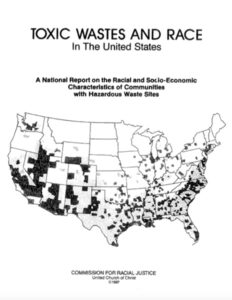
In 1987, the United Church of Christ Commission for Racial Justice released their Toxic Wastes and Race report which demonstrated a direct relationship between the siting of toxic waste facilities and communities of poverty and/or color. Indeed, race is the most significant predictor of the location of hazardous waste facilities. A follow up report, Toxic Wastes and Race at Twenty, 1987-2007: Grassroots Struggles to Dismantle Environmental Racism in the United States, was released 20 years after the original. The updated report sought to measure the impact of environmental racism and progress achieved over the last 20 years. The report demonstrated that environmental laws did not protect communities of color any more than they did 20 years ago when the original report was commissioned.
Bridging History to Modern Action
The disparities we observe in our cancer data are the direct footprint of this history of discriminatory zoning, industrial siting, and systemic disinvestment. While the early 2020s saw historic federal investments in environmental justice through the Inflation Reduction Act and Justice40 initiative, subsequent federal rollbacks have dismantled these programs. Today, state cancer coalitions are the frontline defense.
Cancer coalitions can successfully advance environmental justice on the ground by integrating environmental determinants of health directly into state cancer plans. Designing these efforts within standard, CDC-aligned Social Determinants of Health frameworks protects vital funding while actively dismantling systemic geographic exposures that drive unequal cancer rates.
Watch the video below to explore how the roots of the EJ movement paved the groundwork for today’s environmental cancer risk reduction strategies.